

Last updated: July 4, 2026
Flixprime: Your Ultimate IPTV Destination for 2026
Get the Best IPTV Subscription with Flixprime | 17,000+ Channels & 117,000 VOD
Select Your Plan

4K/FHD/HD
17,000+ Channels
117,000+ VOD
EPG
Anti Freeze™
8.0 Technology
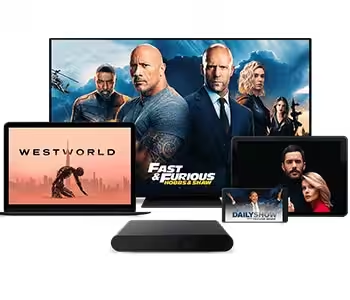
Support all devices
24/7 Support
7 Days Money Back Guarantee
One Time Payment

4K/FHD/HD
17,000+ Channels
117,000+ VOD
EPG
Anti Freeze™
8.0 Technology
Support all devices
24/7 Support
7 Days Money Back Guarantee
One Time Payment

4K/FHD/HD
17,000+ Channels
117,000+ VOD
EPG
Anti Freeze™
8.0 Technology
Support all devices
24/7 Support
7 Days Money Back Guarantee
One Time Payment
 Try It With Zero Risk
No Risk, All Reward - Best IPTV Service.
✓ 24-hour full refund — change your mind, get every dollar back ✓ 7-day partial refund — we cover the days you haven't used ✓ Cancel anytime (Trials are Non-Refundable.)IPTV has transformed the way we consume television content, allowing us to access a wide range of channels and on-demand content over the internet. The concept of IPTV is not new, as it has been around since the 1990s, but it wasn’t until the early 2000s that it began to gain widespread popularity.
The inventor of IPTV is a visionary individual who saw the potential of delivering television content over the internet and conceptualized a system that would revolutionize the way we watch TV. Their groundbreaking innovation has had a profound impact on the entertainment industry, and millions of people around the world now enjoy the benefits of IPTV.
So, who is the inventor of IPTV, and what led them to create this game-changing technology? Let’s dive into the fascinating story of the mind behind IPTV and explore the impact of their creation.
According to a report by ResearchandMarkets, the global IPTV market is projected to reach $117.07 billion by 2025, with a CAGR of 13.7% during the forecast period. This data emphasizes the growing popularity and demand for IPTV services globally, highlighting the significance of the inventor’s contribution to the entertainment industry.
One of the key drivers of the IPTV market is the increasing demand for high-quality, on-demand content. With the rise of streaming services such as Netflix, Hulu, and Amazon Prime Video, consumers are seeking more convenient and flexible ways to access their favorite TV shows, movies, and sports events. IPTV has emerged as a solution that meets these demands, offering a seamless and customizable viewing experience for users.
The inventor of IPTV recognized the evolving needs of television audiences and foresaw the potential for delivering content over the internet. Their innovative approach to merging television and internet technologies has paved the way for the IPTV revolution, shaping the future of entertainment consumption.
The impact of IPTV is not limited to consumer experiences, as it has also transformed the business models of television networks and content providers. IPTV has enabled these entities to reach wider audiences, monetize their content in new ways, and adapt to the changing landscape of media consumption.
In conclusion, the inventor of IPTV is a pioneering individual whose vision and innovation have reshaped the entertainment industry. Their contribution has accelerated the evolution of television and internet technologies, creating new possibilities for content delivery and consumption.
As we continue to witness the growth of the global IPTV market, it is evident that the inventor’s legacy will endure through the profound impact of their creation. Their visionary approach to merging television and internet technologies has left an indelible mark on the way we watch and enjoy TV, inspiring further advancements in the realm of entertainment.
Sources:
– ResearchandMarkets. “Internet Protocol Television (IPTV) Market – Growth, Trends, and Forecasts (2020 – 2025).” Business Wire, 20 May 2020, www.businesswire.com/news/home/20200520005376/en/Internet-Protocol-Television-IPTV-Market—Growth-Trends-and-Forecasts-2020—2025—ResearchAndMarkets.com
Everything You’re Wondering — Answered Straight
No fluff. No fine print. Just the honest answers our support team gives every day.
Yes. FlixPrime is a streaming service that aggregates publicly available channels and content sources — the same way a cable provider does. You're paying for the service, infrastructure, and support — not the content itself. Over 800,000 users across 40+ countries use FlixPrime daily without issue.
That said, streaming laws vary by country. You're responsible for ensuring your usage complies with your local regulations. If you're unsure, our support team can help clarify for your specific location.
1. No physical infrastructure. Cable companies maintain expensive networks of cables, dishes, and trucks. We don't — everything streams over the internet you already pay for.
2. No middlemen. We aggregate directly. Cable bundles inflate prices to pay for layers of distributors, advertisers, and bureaucracy.
3. No long-term contracts. Cable locks you in for 12-24 months to lock in revenue. We earn your business month by month, year by year.
The result: same channels, same quality, 90% less cost.
Not during your active subscription. Whatever plan you buy today, you pay that price for the full duration (1, 6, or 12 months).
When you renew, you'll get first access to the lowest available rate — existing customers always get better pricing than new sign-ups.
No. Never. The 7-day access is a one-time $8 payment — there's no auto-renewal, no surprise charges.
When the 7 days end, your access pauses. If you want to continue, you choose a plan and pay manually — on your terms. We'd rather you decide because you love the service, not because you forgot to cancel.
Yes. If you start with the 1-month plan and want to upgrade to annual, just contact support and we'll credit your unused days toward the longer plan. No penalty, no hassle.
Country: FlixPrime works in 40+ countries worldwide — US, UK, Canada, Australia, all of Western Europe, most of Latin America and the Middle East. If you can stream Netflix where you live, FlixPrime will work.
Devices: Smart TVs (Samsung, LG, Sony, TCL, Hisense), Firestick / Fire TV, Android TV boxes, iPhone, iPad, Apple TV, MAG boxes, Roku (sideload), Windows, Mac. If your device runs apps, it runs FlixPrime.
Visa, Mastercard, American Express, and Stripe (which covers Apple Pay and Google Pay). All payments are encrypted and processed by industry-standard PCI-compliant providers — we never see or store your card details.
Three safety nets:
- First 24 hours: 100% refund, no questions asked
- First 7 days: Partial refund (we cover the days you didn't use)
- Anytime: just email us. No phone calls, no retention scripts, no guilt trips.
Our support team responds on WhatsApp in under 2 minutes during business hours.
Note: (No Refunds for 7-Day Trial)
Check our refund policy: https://www.flixprime.us/refund-policy/
Fair concern. Here's why FlixPrime isn't going anywhere:
- 12 years in operation (since 2014)
- 800,000+ active users across 40+ countries
- 2,518 verified reviews at 4.8/5
- Real support team on WhatsApp, email, and live chat
- Payments processed through Stripe and Shopify pay— both require legitimate business verification
We didn't appear last week, and we're not going anywhere.
Testimonials
What they're saying

Please review your experience with our IPTV services that you purchased
Related reading
- Top IPTV Services for 2024: Best Streaming & Subscription Options
- The Rise of IPTV: How Internet Protocol Television is Changing the Way We Watch TV
- Flixprime IPTV – Best IPTV Service Provider of 2026
Related entities
- The Ultimate Guide to IPTV: Streaming Netflix and More
- The Future of TV Viewing: How IPTV and Netflix are Changing the Game
- IPTV vs Android Box: Which Streaming Option is Right for You?
References
- IPTV uses Internet Protocol (IP) to deliver television content over packet-switched networks rather than traditional terrestrial, satellite, or cable formats — Internet Engineering Task Force (IETF) (Develops and maintains internet protocol standards including those used for IPTV transmission)
- The standardization of video compression technologies like MPEG and improvements in broadband infrastructure enabled commercial IPTV services to become viable — International Telecommunication Union (ITU) (United Nations specialized agency responsible for information and communication technology standards)